AMH, or anti-Müllerian hormone, is a protein produced by cells in the developing follicles of a woman’s ovaries. It is a crucial marker of a woman’s reproductive health and is used to predict the number of eggs she has available for fertilisation. The AMH test measures the level of AMH in a woman’s blood and provides valuable information about her fertility potential.
The test is often done with other tests, like follicle-stimulating hormone (FSH) and luteinizing hormone (LH), to get a complete picture of a woman’s reproductive health.
Who requires an AMH test?
Women who are planning to start a family or are concerned about their fertility may benefit from an AMH test. Additionally, women who are experiencing infertility or are undergoing fertility treatment may also need the test to help diagnose and guide treatment options. The test is also recommended for women who are over 35 and considering pregnancy, as the woman’s age is a major factor in her fertility potential.
Normal AMH Range
The AMH test normal range varies with age, but a general range is considered to be 1.5–4.0 ng/mL. Women in their reproductive years typically have higher levels of AMH, while levels decrease as a woman approaches menopause. Women with polycystic ovary syndrome (PCOS) may have higher than normal levels of AMH.
Symptoms of Low AMH
Low AMH levels do not typically cause any symptoms, but they can indicate an increased risk of infertility. Women with low AMH may have irregular periods, have trouble getting pregnant, or have had miscarriages in the past.
Low AMH Treatment
Low AMH levels can indicate a decrease in the number of eggs available for fertilisation and an increased risk of infertility. There is no specific low AMH treatment option, but there are options for improving fertility.
In vitro fertilisation (IVF) is one option for women with low AMH. This process involves removing eggs from the ovaries and fertilising them with sperm in a lab; the resulting embryos are then implanted back into the uterus.
Lifestyle changes, such as maintaining a healthy weight, eating a balanced diet, and reducing stress, may also help improve fertility. In some cases, medication, such as letrozole, may be prescribed to increase AMH levels.
How to increase AMH level?
There is currently no proven method for increasing AMH levels, but there are steps women can take to improve their overall fertility and increase their chances of getting pregnant.
Lifestyle changes, such as maintaining a healthy weight, eating a balanced diet, and reducing stress, can help improve fertility. In addition, women can take fertility-enhancing supplements, such as myo-inositol and melatonin, which have been shown to improve egg quality and increase AMH levels in some women.
Women should also avoid smoking, drinking too much alcohol, and being exposed to toxins, all of which can impact their fertility.
What Our Patients Often Ask
AMH test price
The AMH test price ranges roughly between ₹1,500 and ₹2,500, depending on the laboratory or clinic.
Prices can vary, but it is the proper guidance and follow-up sessions that are important. At Prime IVF
Centre, Dr. Nishi Singh ensures patients not only get the test done but also understand their fertility
potential and the next steps clearly. With advanced technology and supportive care, the centre makes
fertility planning easier, giving couples both reliable results and affordable options.
How is AMH test done
The AMH test is a very basic blood test used to estimate the ovarian reserve by gauging the quantity of
anti-Mullerian hormone in the blood. Unlike certain fertility tests, this one can be conducted on any
day of the menstrual cycle, providing a clear picture of potential fertility.
AMH test normal range
Regular AMH test ranges may reflect changes with age, yet an age range of 1.5 to 4.0 ng/mL is usually
healthy in females who are of childbearing age. The results are usually higher in PCOS females, whereas
lower rates can indicate low fertility potential. At Prime IVF centre, Dr. Nishi Singh decodes these
figures and helps the patients know the best course of action to take in family planning or treatment
against infertility.
AMH test when to do
The AMH test is taken at any point in the time during menstrual cycle because hormone levels do not vary
like other factors of fertility. It is particularly helpful to women who intend to become pregnant,
those already older than 35 years, or anyone who has issues with fertility.
AMH levels PCOS
The females whose condition is PCOS tend to possess higher than usual AMH levels, often above about 4–5
ng/mL, and many fall around 6–8 ng/mL (roughly two to three times higher than peers) because they have
boosted small follicle production in the ovaries. Although it is not necessarily fertility-related, this
may interfere with ovulation and make conceiving more difficult without proper advice. AMH results,
along with other tests, provide a clear overview of reproductive health, so that patients with PCOS
would receive the appropriate treatment and care.
Normal AMH levels by age
AMH levels drop as people get older, so what would be normal varies. Women in their 20s and early 30s
tend to have higher levels, between 1.5-4.0 ng/mL, and the levels begin to decline in the mid-30s and
further decrease towards menopause. Low values may signal reduced egg reserve.
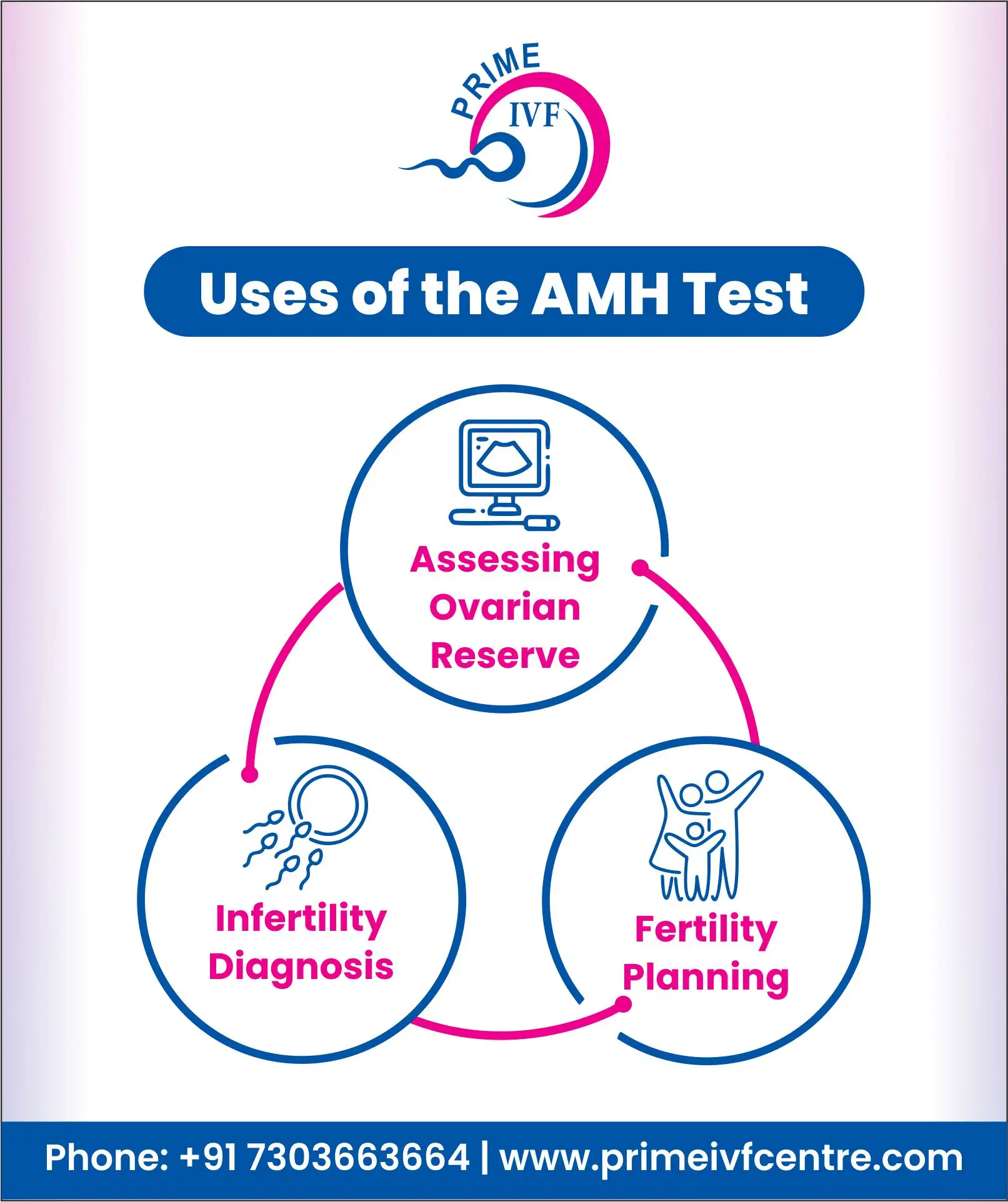
Uses of the AMH Test
The AMH test is useful in many ways.
- Assessing Ovarian Reserve: The test is used to find out how many eggs a woman still has and how fertile she is likely to be.
- Fertility Planning: The AMH test can help women understand their fertility and make informed decisions about starting a family.
- Infertility Diagnosis: The test can be used to diagnose infertility and guide treatment options.
Benefits of the AMH Test
Some of the benefits of AMH tests are:
- Reliability: Compared to tests like FSH and LH, the AMH test gives a more accurate picture of a woman’s ability to have children.
- Convenience: The test can be taken at any time during a woman’s menstrual cycle and is not influenced by hormonal fluctuations.
- Early Detection: The test can find problems with a woman’s ovarian reserve early on, so that treatment and help can be given right away.
Conclusion
The AMH test provides valuable information about a woman’s reproductive health and fertility potential. Women with low AMH levels may face an increased risk of infertility, but there are options, such as IVF and lifestyle changes, that can help improve their chances of getting pregnant. Understanding the AMH test normal range, symptoms of low AMH, and how to increase AMH levels is important for women who are looking to start a family or who have concerns about their fertility.
Why choose Prime IVF Centre?
If you’re considering an AMH test, choosing Prime IVF can ensure that you receive the best possible care and guidance. Our experienced team of fertility specialists will guide you through the process, providing you with a comprehensive understanding of your reproductive potential and fertility. With the latest technology and advanced medical facilities, we are committed to providing our patients with the best results to help them make informed decisions about their fertility journey. Contact Prime IVF today to learn more about the AMH test and take the first step towards starting your family.
FAQ
-
एएमएच परीक्षण क्यों की जाती है? (Why is AMH test done?)
एएमएच परीक्षण एक साधारण रक्त परीक्षण है जो एंटी-मुलरियन हार्मोन के स्तर को मापता है, जोकि किसी महिला के अंडे की संख्या की गणना करने के लिए किया जाता है। हालाँकि एएमएच परीक्षण आपके अंडों की संख्या की गणना से जुड़ा है, लेकिन यह आपकी प्रजनन क्षमता का अनुमान नहीं लगाता है।
-
सामान्य एएमएच स्तर क्या है? (What is normal AMH level?)
एएमएच का सामान्य स्तर 1.5-4.0 एनजी/एमएल हैं। लेकिन एएमएच स्तर उम्र के साथ बदलती रहती हैं। विशेषज्ञ की माने तो महिलाओं में प्रजनन के वर्षों में एएमएच का स्तर ज्यादा होता हैं और जैसे जैसे महिला की उम्र बढ़ती जाती है उनके एएमएच का स्तर कम होते जाता है।
-
क्या एएमएच गर्भावस्था को प्रभावित करता है? (Does AMH affect pregnancy?)
जैसा की हम जानते है की एएमएच परिक्षण महिलाओं के ओवेरियन रिज़र्व की जानकारी के लिए किया जाता है। एएमएच का उच्च स्तर यह दर्शाता है की एक महिला में माँ बनने की क्षमता हो सकती है। लेकिन विशेषज्ञ बताते हैं की सिर्फ एएमएच स्तर की जाँच करके किसी महिला के प्रजनन क्षमता का अनुमान लगाना कठिन हो सकता है।
-
मैं एएमएच का स्तर कैसे बढ़ा सकती हूं? (How can I increase AMH levels?)
आप अपने खानपान में बदलाव करके एएमएच का स्तर बढ़ा सकते हैं। विशेषज्ञ ऐसा मानते है की अधिक पत्तेदार सब्जियाँ खाने से आपके एएमएच स्तर में बढ़ोतरी हो सकती है। ऐसा इसलिए की पत्तेदार सब्जियाँ आवश्यक पोषक तत्वों से भरपूर होती हैं जो प्रजनन क्षमता और एएमएच स्तर को बढ़ावा देने में मदद कर सकती हैं। आप फाइबर के सेवन को भी बढ़ा सकते हैं क्युकी उच्च फाइबर वाला आहार हार्मोन को संतुलित करने में मदद कर सकता है अतः यह एएमएच के स्तर में सुधार कर सकता है।
-
क्या कम एएमएच स्तर के साथ गर्भधारण करना संभव है? (Is it possible to conceive with low AMH levels?)
यदि आपका एएमएच का स्तर कम है तो आप स्वाभाविक रूप से गर्भवती हो सकती हैं क्योंकि इसमें हर महीने उतार-चढ़ाव होता है। हालाँकि, यदि आपका एएमएच स्तर कम है तो आपके लिए अपने अंडों से या डोनर अंडों की मदद से स्वाभाविक रूप से गर्भवती होना संभव है। आपका निम्न एएमएच स्तर आपकी प्रजनन क्षमता तय नहीं करता है क्युकी आपकी प्रजनन क्षमता में सुधार करने के कई अन्य तरीके भी हैं।


